Artificial Intelligence, or AI, is no longer some far off idea you only see in science fiction. Honestly today it feels like it is in our day to day life. It suggests what you watch on streaming platforms, it assists doctors with diagnosing diseases, it spots online fraud, and it even supports students and busy professionals with writing, coding, and research. From smartphones all the way to self driving cars
But even with all that, a lot of people still ask things like, what exactly is AI, how does it work. Is it the same thing as machine learning, and can AI actually replace humans?
If you are just getting started, this beginner’s guide with lots of details should clear things up in pretty simple language. By the end of this article you should be able to explain what is artificial intelligence really is, how it works, the different types and what the future might look like for AI.
What Is Artificial Intelligence (AI)?
Artificial Intelligence (AI) is a field within computer science, focused on building devices and software that can carry out tasks which usually demand human intelligence.
These tasks may involve:
- Learning from data
- Solving problems
- Understanding languages
- Images recognition and Speech
- Decisions making
- Generating images, videos, from text and code too.
In plain terms, AI helps computers “think”, learn, and fix problems in a manner that resembles human intelligence.
And unlike traditional software that follows fixed instructions, AI systems can look at data, spot patterns, and gradually enhance their performance over time.
A Brief History of Artificial Intelligence
Even though AI looks like a new technology, its origins go back, to be honest, several decades already.
1950 – The Start
British mathematician Alan Turing proposed the well known Turing Test, which is a method to determine whether a machine can show intelligent behaviour that feels pretty similar to people.
1956 – Artificial Intelligence Birth
The word Artificial Intelligence was officially presented at the Dartmouth Conference by computer scientist John McCarthy, who is called the father of AI.
1980s – The expert systems
Companies began using AI driven expert systems to help for medical diagnosis, financial choices, and industrial workflows.
2010s – The machine learning
Progress in computing power and access to large data sets has accelerated progress in machine learning and deep learning.
2022–2026 – Generative AI, the new chapter
AI tools that can craft human like material changed whole workflows. Today AI can write articles, produce artwork, create videos, help programmers, and respond to tricky questions in seconds.
How Does Artificial Intelligence Work?
Essentially, AI is all about learning pattern through large volumes of data.
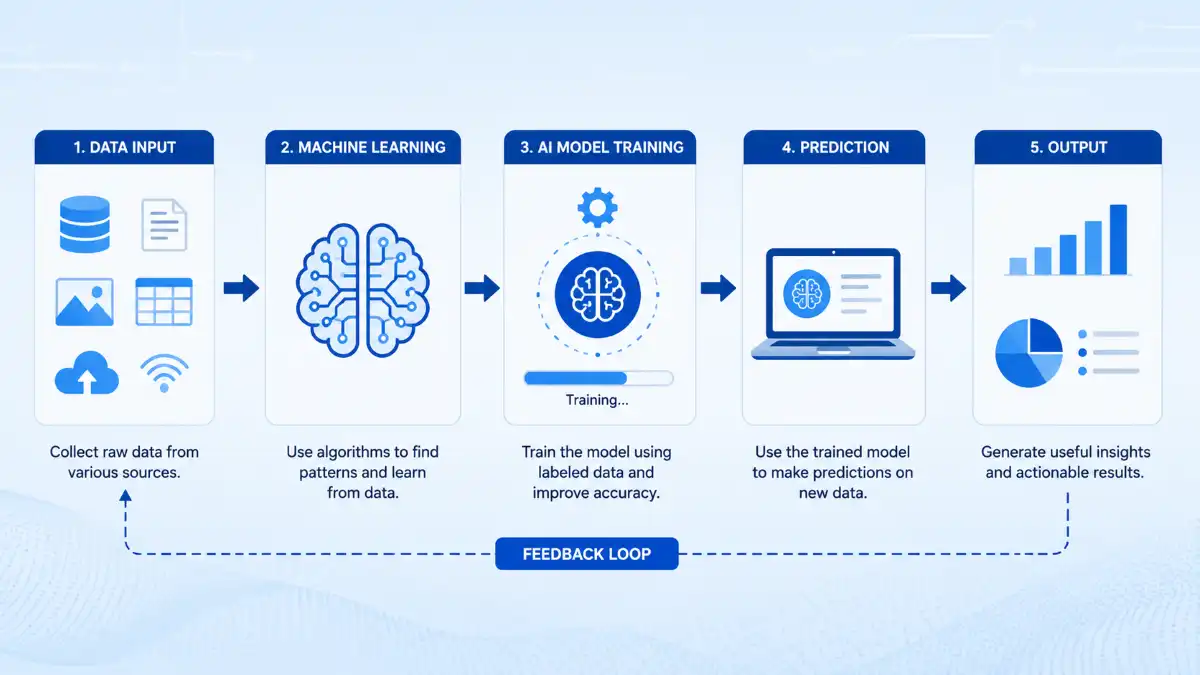
Here is the entire process takes place in four steps:
1. Data Collection
AI gets trained by using very large datasets, like text, photos, videos, audio, and also numbers.
The accuracy and usefulness of that data matters a lot, because it will push the AI performance up or down.
2. Training
During training, the algorithms study the data, figure out relationships, and patterns.
For instance :
- AI identify cats among lot of cats photos.
- Millions of text document help language models grasp grammar, and context too.
3. Prediction
After AI get trained, it can make predictions or even decisions on the basis of new information.
Some examples are:
- Detecting spam emails
- Recommending movies
- Language translation
- Answering questions
4. Continuous Improvement
The artificial intelligence system constantly improves itself as it acquires new data and user interaction.
Types of Artificial Intelligence
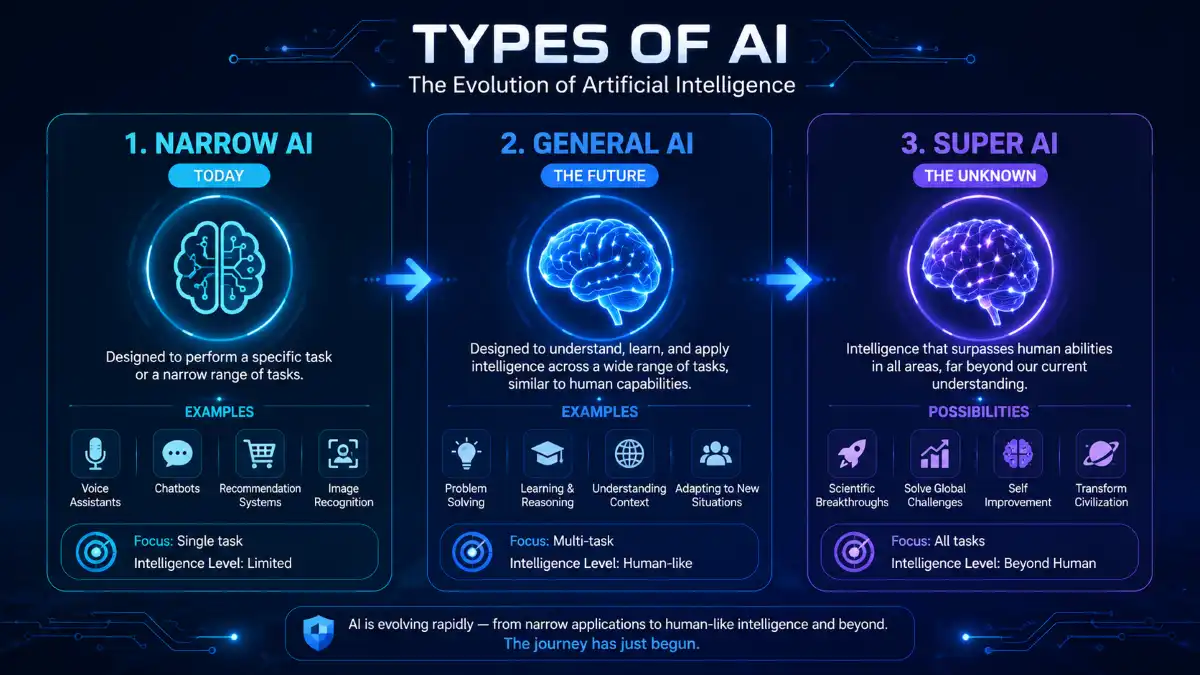
AI can be classified based on its capabilities.
1. Narrow AI (Weak AI)
This one is the most common AI available right now.
It’s made for a single specific job.
Examples are:
- Voice assistants
- Recommendation systems
- Chatbots
- Email spam filters
- Navigation apps
Even if it’s really effective, Narrow AI still can’t handle things outside of what it was programmed to do.
2. General AI (Strong AI)
General AI is about machines that can understand, pick up knowledge, and handle any mental activity that a human can manage.
For now, General AI is still a research goal, and it’s not existed in real world applications.
3. Super AI
Super AI is a hypothetical idea of intelligence that would be better than humans basically in every area.
At present, Super AI exists only as a theoretical concept.
Common AI Technologies
Modern AI includes several important technologies.
1. Machine Learning
Allows systems to improve automatically by learning from data.
2. Natural Language Processing (NLP)
It helps AI to understand and generate language, in a way that feels more natural.
Examples include:
- Translation
- Chatbots
- Voice assistants
3. Computer Vision
Computer Vision is more or less about computers analyze and understand pictures and videos.
Common uses for that include:
- Face recognition
- Medical imaging
- Autonomous vehicles
4. Speech Recognition
Basically, speech recognition converts spoken language into text.
Examples include voice assistants and automated customer support.
5. Generative AI
Creates new content such as:
- Articles
- Images
- Videos
- Music
- Computer code
Real-Life Applications of AI
In the real world, AI is actually changing many industries, almost everything.
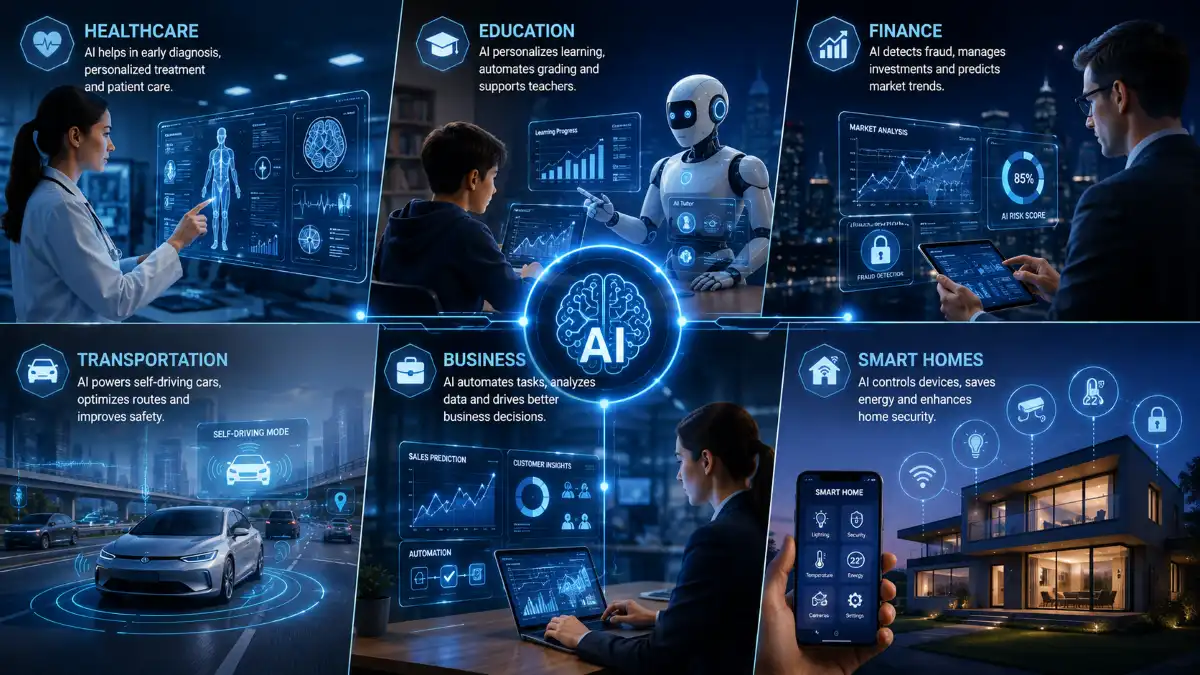
1. Healthcare
AI helps doctors by looking at medical scans, identifying diseases, and assisting with personal treatment plans. It can also be quite useful in making quick decisions and spotting patterns more carefully.
2. Education
Students are using AI for tutoring, language learning, research assistance and exam preparation. Meanwhile teachers use AI to automate grading, and to create learning materials, that save time when everything is due.
If you’re a student, we’ve also put together a list of the Best AI Tools for Students in 2026, including both free and paid options.
3. Finance
Banks use AI to:
- Detect fraud
- Evaluate credit risk
- Automate customer support
- Analyze investments
4. E-commerce
Online stores use AI for:
- Personalized recommendations
- Product searches
- Inventory management
- Customer service chatbots
5. Transportation
AI powers:
- Traffic prediction
- Route optimization
- Driver assistance systems
- Self-driving vehicle research
Some teams work on it daily, for safer driving and smarter navigation.
6. Content Creation
Writers, marketers, designers, and developers use AI for:
- Writing articles
- Creating graphics
- Editing videos
- Generating code
- Brainstorming ideas
It blends creativity with automation, in a pretty practical way.
Popular AI Tools in 2026
Many AI-powered tools are available for different tasks.
Like, some popular categories look like this:
AI Assistants
- ChatGPT
- Google Gemini
- Claude
- Microsoft Copilot
AI Image Generators
- Midjourney
- Adobe Firefly
- Stable Diffusion
AI Coding Tools
- GitHub Copilot
- Cursor
- Codeium
AI Design Tools
- Canva AI
- Adobe Express AI
In general, each tool is tuned for particular work. So, AI becomes easier for students, creator, businesses, and professionals.
If you’re new to AI tools, check out our guide to the Top 10 AI Tools for Beginners in 2026 , to discover easy-to-use tools for everyday tasks.

Benefits of Artificial Intelligence
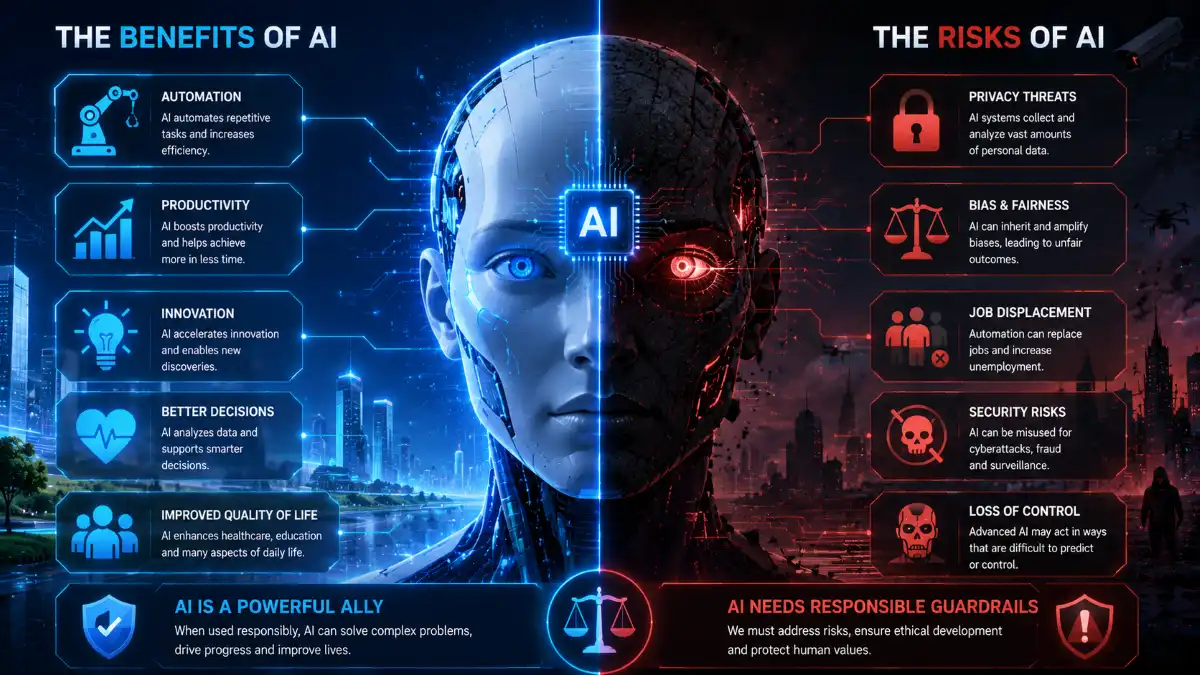
AI brings a lot of advantages.
i. Increased Productivity
- AI can automate the repetitive work, so people end up focusing on what is more important.
ii. Faster Decision-Making
- AI analyzes large number of datasets in seconds.
iii. Better Accuracy
- When AI is trained properly, it can reduce human error in many situations.
iv. Personalized Experiences
- AI suggests content using user preferences on Streaming platforms, online stores, and learning platforms.
v. 24/7 Availability
- AI chatbots and virtual assistants can provide support any time, like no breaks, no downtimes.
vi. Innovation
- AI increase the rate of research in medicine, science, engineering, and technology.
Challenges and Limitations of AI
Although AI is powerful, it also has limitations.
AI Can Make Mistakes
The answers an AI generates can include factual problems, or information that is outdated.
So, always verify or double-check any important information.
Privacy Concerns
AI systems depend on huge data sets. That brings up questions about how personal information is gathered and then used to avoid AI risks.
Bias
If the training material has bias, the AI might give results that are unfair, or inaccurate.
Developers keep working on it, to reduce these issues.
Job Displacement
AI might automate certain repetitive roles, but at the same time it’s creating new opening in areas, like AI development, data analysis, cybersecurity, and digital transformation.
High Development Costs
Creating advanced AI systems usually needs heavy computing power, skilled experts, and a solid infrastructure.
Can AI Replace Humans?
One of the biggest questions around AI is it will replace human workers.
The answer is not simple as yes or no. AI often shines with repetitive, data-driven, rule based tasks. But humans still have these qualities that AI can’t really in a true sense, like creativity, emotional intelligence, ethical judgment, empathy, and handling complex choices when the situation is not predictable.
So instead of fully replacing people, AI is more likely to transform how work gets done. A lot of industries are already using AI as a tool for boosting productivity, automating routine tasks, and helping with smarter decision-making, yet human knowledge is still pretty crucial.
How to Start Learning AI
If you’re like AI, for real, try these beginner friendly steps:
- Get the basic ideas of AI and machine learning.
- Check out widely used AI tools, and its features.
- Work on writing good prompts for AI assistants.
- Keep updated with AI news and newer technology.
- Learn some simple programming basics (like Python) if you want to create AI apps.
- Go through beginner courses on AI, Machine learning, and Data science.
- Use AI responsibly, to verify the information you get and also respect privacy.
Frequently Asked Questions (FAQs)
Q1. Is Artificial Intelligence the same as Machine Learning?
Ans. No , Artificial Intelligence is broader field, while Machine Learning is a branch of AI that lets systems learn from data, without need of programmed for every task.
Q2. Is AI dangerous?
Ans. AI itself is just a tool. The outcome will depend on how the technology is designed, how it is implemented, and how it is used. Responsibility and clarity should be observed for risks to remain at minimum.
Q3. Do you need coding skills to use AI?
Ans. No. A lot of AI tools are made for everyday users and you don’t need programming knowledge to get started. Still, learning how to code can help if you want to build, or customize, AI applications, more deeply.
Q4. Is AI replacing jobs?
Ans. AI is making some jobs obsolete and changing others but it is also creating new jobs in fields like AI development, data analysis, prompt engineering and cyber security. By learning new skills one is able to adapt.
Q5. Can AI think like humans?
Ans. Today’s AI can handle information, spot patterns, and generate answers, but it doesn’t have consciousness, emotions, or self-awareness. It imitates smart behavior, rather than truly “thinking” like a human being.

Conclusion
Artificial Intelligence has come from a research idea into one of the most transformative technologies of our time. It is reshaping industries, boosting productivity, creativity, and generally making advanced tech easier to reach for people across the globe.
As a beginners who just start to getting the basics of AI is really the first move, if you want to use it well and also in a responsible way. Whether you’re a student, a working professional, an entrepreneur, or you’re simply curious about technology, learning how AI works can help you deal with a future where “smart” systems are showing up more often.
AI as a strong assistant, not as a direct substitute for human intelligence. When people add their own creativity, careful reasoning, and ethical judgment, then pair that with AI’s rapid pace and efficiency, individuals and organizations can tap into fresh opportunities and tackle tricky problems more effectively.